




Clínica Girona connects the stomach and small intestine of a patient with an innovative endoscopic technique without the need for surgical intervention.

For the first time in Girona, Gastroenterologist Dr. Ferran González Huix installs an Axios stent from Boston Scientific in an ecoendoscopy-guided gastrojejunostomy.
Girona, 28 January 2020. .- Using an innovative technique, Clínica Girona gastroenterologist Dr. Ferran González Huix has connected the stomach to the small intestine of a patient, without the need for surgical intervention. “We have performed, for the first time in Girona, and I am aware that it has been done very few times in Catalonia, an ecoendoscopy-guided gastrojejunostomy (Endoscopic Ultrasonography), which consists of implanting a stent in a patient to create a connection between the stomach and the jejunum (initial part of the small intestine) without the need for surgical intervention,” states Dr. González Huix.
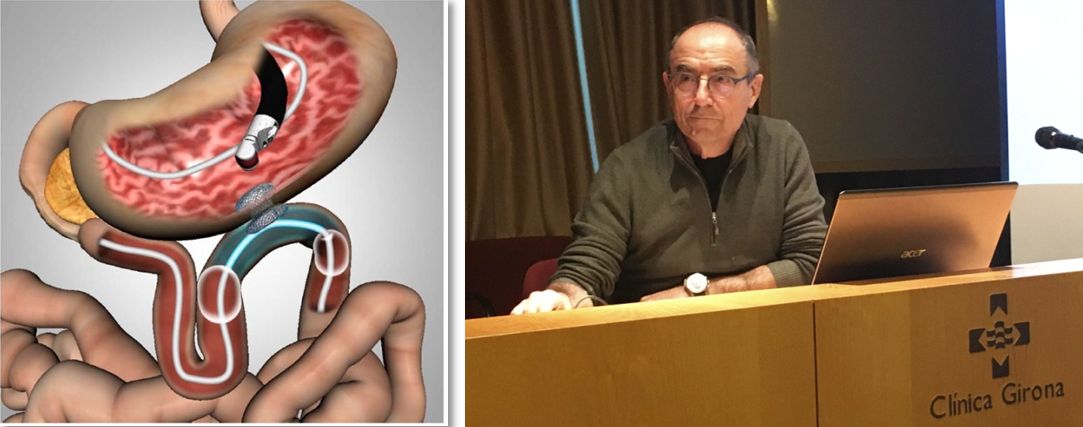
“This technique,” states the gastroenterologist, “can replace surgeries for connecting these organs (stomach and proximal small intestine), which necessitate general anaesthesia, hospital stays lasting several days, occasionally admission to the Intensive Care Unit post-operatively, and can carry particular risks for elderly individuals with associated illnesses.”.
According to Dr. González Huix, the aim of this type of intervention is to achieve a “by-pass” for the passage of ingested food that cannot move into the small intestine when there are obstructions in the distal part of the stomach or duodenum: “This particularly occurs in cases of benign or malignant diseases of the surrounding organs (pancreas, liver, gallbladder) or of the stomach or duodenum itself. In these cases, the narrowing of the lumen of these organs may prevent the stomach from emptying, leading to vomiting and food intolerance. Besides surgical union (anastomosis) between the stomach and the jejunum (surgical gastrojejunostomy), prostheses placed through the narrowed (stenotic) part of the stomach or duodenum have also sometimes been used. The function of these prostheses is not optimal, and they often become obstructed or malfunction.”.
Innovative technique
Endoscopic gastrojejunostomy is possible thanks to the recent availability of new types of prostheses (stents) that manage to join these organs and connect them. This type of prosthesis is called a Lumen Apposing Metal (LAM) stent, and the best known or most used is the “Hot-Axios” stent marketed by Boston Scientific.
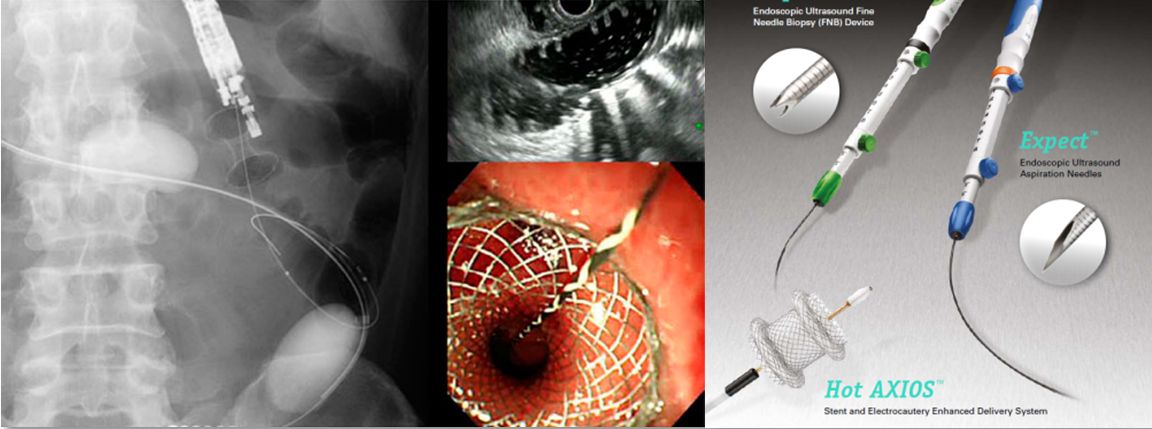
The methodology used to carry out the technique is via Endoscopic Ultrasound (EUS). This is a specialised endoscope that provides an internal image of the stomach and also has an ultrasound transducer at its distal end. This device is inserted through the mouth into the stomach, and once there, using ultrasound imaging, the small intestine closest to the stomach is located, beyond the narrow passage that prevents food intake. Once this segment of the small intestine is identified and filled with fluid (water, contrast agent, and a dye), it is punctured with a catheter that carries an electrocoagulation system (to achieve puncture and access) and transports the “Stent” itself, folded, inside. Following the puncture to access the intestine, the prosthesis is released, first from its distal end inside the small intestine and then from the proximal end in the stomach.
This technique achieves a “by pass” or shortcut without needing to operate on the patient and with improved functionality (stomach emptying into the small intestine), which is better than stents placed through the stenosis. The only limitation of this technique is the inability to detect the small intestine segment by echoendoscopy, which happens on rare occasions. This technique, described about 2 years ago, has been performed worldwide for approximately 1 year and is the first time it has been performed in Girona, and one of the first times in Catalonia, according to Dr. Ferran González Huix. The patient on whom this technique was performed was able to start drinking liquids and later a full diet within 12-24 hours. They were discharged within 48 hours.
