




Cetir-Clínica Girona implements the first PET/CT scan to be installed in Girona's regions.

Hybrid PET/CT technology allows the integration, in a single diagnostic test, of the benefits of nuclear medicine and conventional radiology.
PET/CT scans offer more precise, rapid, and comfortable diagnostic imaging for patients. Until now, it was necessary to travel to Barcelona to undergo these types of tests.
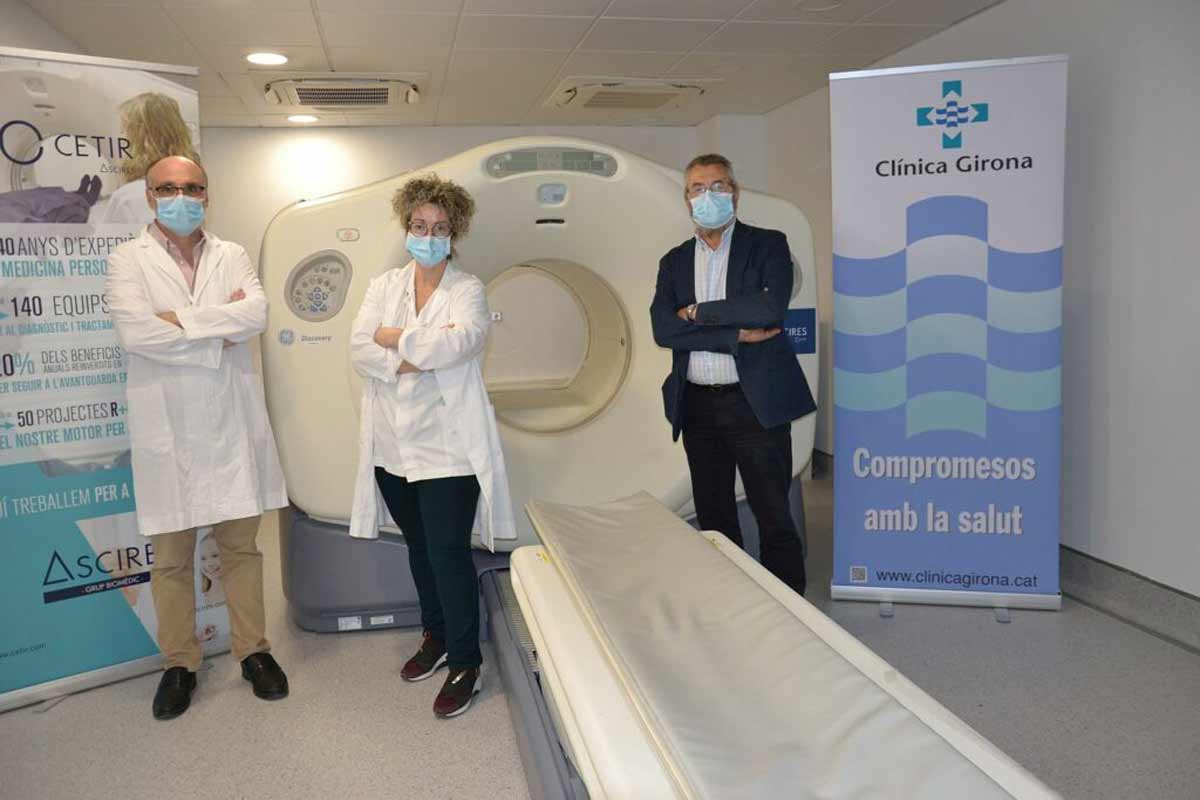
Girona, 3 June 2020. Cetir-Clínica Girona is launching the first PET/CT scanner this week to be installed in the Girona region. From now on, residents of Girona will no longer have to travel to Barcelona to have a PET/CT scan, which is used to determine the extent of diseases such as cancer, heart conditions, infections, memory disorders or cognitive decline, inflammatory processes, or vasculitis. This hybrid technology equipment integrates the benefits of nuclear medicine and conventional radiology into a single diagnostic test, offering a more precise, faster, and more comfortable diagnostic imaging for the patient.
The Grup Clínica Girona was already a pioneer in bringing Nuclear Medicine to Girona, together with Cetir, integrated into the Ascires Biomedical Group, and is now once again leading the way by installing the first PET/CT scanner in the Girona region, shortly before the Clinic's move to the new building that is being constructed at the southern entrance to the city. According to Carles Espígol, manager of Clínica Girona, “we prioritised making this equipment available to the people of Girona as soon as we had the opportunity, rather than waiting for the Nova Clínica Girona to be finished, where this PET/CT scanner was indeed included as a new diagnostic imaging service”.
Dr Sara Guirao, Medical Director of the Nuclear Medicine Department at Cetir-Clínica Girona, states: “This equipment incorporates two of the most powerful diagnostic imaging tools currently available: Positron Emission Tomography (PET) and Computed Tomography (CT). Through this advanced detection technique, images are obtained that simultaneously provide anatomical and functional information, consequently improving the ability to detect and locate disease, making it an advantageous option for offering a diagnosis of maximum precision”. Other key uses include neurological studies in patients with memory disorders or cognitive impairment, patients with neurological diseases manifesting as movement disorders, and the detection, assessment, and monitoring of tumours.
A comprehensive approach to the cancer patient
This new Cetir-Clínica Girona team will perform PET/CT scans that will provide accurate information at very early stages of the disease, which is essential for cancer patients. Both in the diagnosis and in the planning and exhaustive follow-up of therapy, PET/CT is the optimal solution for the needs posed by cancer: it facilitates early tumour detection, enables the study of the response to treatment through biochemical characterisation of changes in cancerous tissue, and allows for personalised therapy and its exhaustive follow-up.
All of this is complemented by greater ergonomics and comfort for the patient, as the equipment has a wider opening diameter than standard diagnostic scanners, ideal for people who are more sensitive to confined spaces or claustrophobic. It also provides extraordinary image quality in less acquisition time. The equipment also features a flat panel that enables radiotherapy planning.
About Cetir Ascires
Ascires is the biomedical group to which Cetir belongs. With Mediterranean roots and a career spanning over 50 years, it is a leader in Spain in Diagnostic Imaging and Nuclear Medicine, as well as in Genetics, and a benchmark in Radiotherapy Oncology.
The biomedical group Ascires focuses its activity on precision diagnosis and treatment, attending to more than 500,000 patients per year and reinvesting an average of 20% of its profits annually in R + D + I; this allows for the constant incorporation of the latest scientific advances and in biomedical technology, both in Diagnostic Imaging and in Genomics and Radiotherapy.
